In the book Powerful: The Indian Woman’s Guide to Unlocking Her Full Potential, Nirupama Subramanian describes four strategies that society, culture, and even our own conditioning use to hold women back: Deter, Diminish, Decorate, and Divide.
Women are often told to be confident, ambitious, and capable. Yet, from an early age, many also receive messages that make it harder to embody these very qualities. Society teaches women when to speak and when to stay silent, what they can aspire to, how they should present themselves, and how they should relate to other women. Over time, these messages can become so familiar that women may not even recognise how deeply they influence their choices.
The four strategies help us understand how social and cultural conditioning can shape women’s beliefs, limit their choices and prevent them from stepping fully into their potential.
1. Deter: Making Women Afraid to Step Forward

The message: “Don’t step out of line, or something bad will happen to you.”
How it plays out: Women are often restricted in the name of safety and family honour. From being told what to wear and where to go to facing social backlash for challenging traditions, fear is used to keep women within prescribed boundaries. For instance, in 2013 a khap panchayat( village council) in Haryana banned girls from wearing jeans and using mobile phones, claiming these encouraged behaviousr that led to crimes against women.
Impact at the workplace: Women may hesitate to take on challenging assignments, put themselves forward for leadership positions, or voice a different perspective and step out of their comfort zones.Over time, this can lead to missed opportunities, reduced visibility, and under-representation in decision-making roles.
2. Diminish: Making Women Question Their Capabilities

The message: “You’re a girl. You can’t do this.”
How it plays out: Women are often raised to believe they are weaker and need male protection, even when it comes to making decisions or standing up for themselves. An HP research showed that women apply for a bigger role only if they feel that they meet 100% of the criteria while men applied for roles if they met 60% of the criteria. Women feel the need to prove themselves again and again.
Impact at the workplace: Women may struggle to recognise their own capabilities, hesitate to take credit for their achievements, or hold back from expressing their ideas. This can affect their confidence, visibility, and willingness to pursue leadership opportunities.Women hesitate to take on newer challenging roles because of self doubt and low self confidence. It shows up as the Imposter syndrome, where women feel that they don’t deserve the success they have achieved.
3. Decorate: Making Women Feel They Must Be Perfect

The message: “You should always meet the high standards we have set for you.”
How it plays out: Women are often praised for being the ideal daughter, devoted wife and selfless mother, with their worth measured by how well they fulfil these roles. There are lofty expectations on women to manage work, family, social commitments and exhibit qualities like modesty, humility, caring and obedience.
India’s Time Use Survey 2024 found that women aged 15–59 who participated in unpaid domestic services spent an average of 305 minutes a day on them. The expectation to manage the home and care for everyone often leaves little room for their own ambitions.
Impact at the workplace: The pressure to be perfect can lead to burnout, reduced risk-taking, and reluctance to take up opportunities unless women feel completely prepared. It can also limit creativity, innovation, and the freedom to learn through mistakes.
4. Divide: Making Women See Each Other as Competition

The message: “You’re on your own. Other women are your competition, not your allies.”
How it plays out: From childhood, girls are often compared with sisters, cousins and friends, who are more attractive, obedient, successful or well-behaved. Such comparisons can create a sense of rivalry and make women feel they must compete for approval rather than support one another. Instead of recognising shared experiences, they may see other women as competitors rather than allies.
Impact at the workplace: Women may miss out on valuable networks, mentorship, sponsorship, and opportunities for collaboration. A lack of solidarity can weaken collective influence and make it harder for women to challenge existing barriers and create meaningful change.
These patterns are not personal failures. They reflect deeply ingrained social and cultural expectations that can shape women’s beliefs and behaviours, often without their awareness. Recognising these forces is an important first step towards questioning them and choosing a different response.
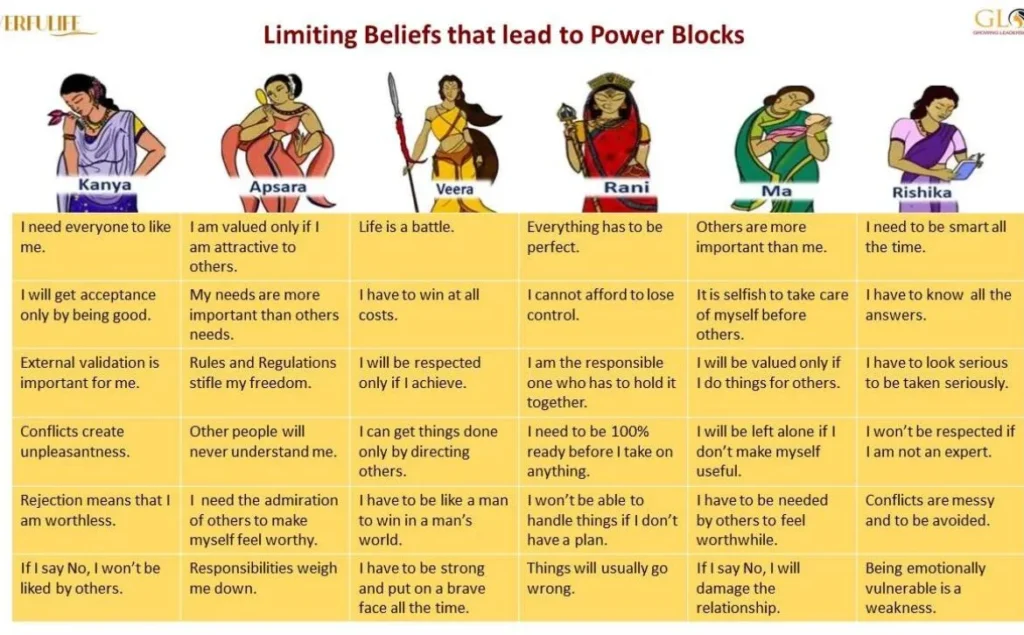
The Six Feminine Powers model offers women a way to build that awareness by recognising their strengths and learning to use them intentionally. Whether it is finding the courage to speak up, trusting one’s capabilities, moving beyond perfectionism, or building meaningful alliances, women can draw on their powers to navigate challenges and claim greater influence in the world around them.
We may not be able to change every expectation society places on women, but we can begin to question the messages we have internalised and choose not to let them define our potential.
Reclaiming power begins when we recognise what holds us back, and discover new ways to move forward. The Six Feminine Powers model gives us a framework and tools to overcome these strategies and take back power.